During the stainless steel sheet metal fabrication process, there are various ways to join components together. A popular choice for joining would be riveting or welding. Both methods vary in terms of the strength of the joint, amount of heat required, and how well the surface will look.
This article is to help you decide which method is best for your fabrication process.
What Is Riveting?

Riveting is a mechanical fixing method which can be used to join two or more stainless steel sheet metal components. When a rivet is inserted into aligned holes, the tail of the rivet is deformed with a riveting tool to form a secure fix.
As this is a mechanical fixing method, the base material isn’t melted when using riveting. This means it can be a useful method when you want to minimise any warping caused by heat within your sheet metal components.
Common Types Of Rivets Used
Depending on the thickness of your materials, joint design, ease of fixing and load requirements will determine what type of rivet can be used.
Solid Rivets
These rivets are solid cylinders with a head. The tail is mechanically deformed to fix components together. These are commonly used for creating strong mechanical joints.
Blind Rivets
These are also known as pop rivets. They can be fixed from one side of your components. Blind rivets are very useful for stainless steel housings, closed profiles and sheet metal components.
Semi Tubular Rivets
These have an open end which makes them easier to deform. They can be used for some sheet metal components and lighter metal components.
Structural Rivets
These are used for stronger joints and can resist vibrations. They are commonly used within industrial applications.
What Is Welding?

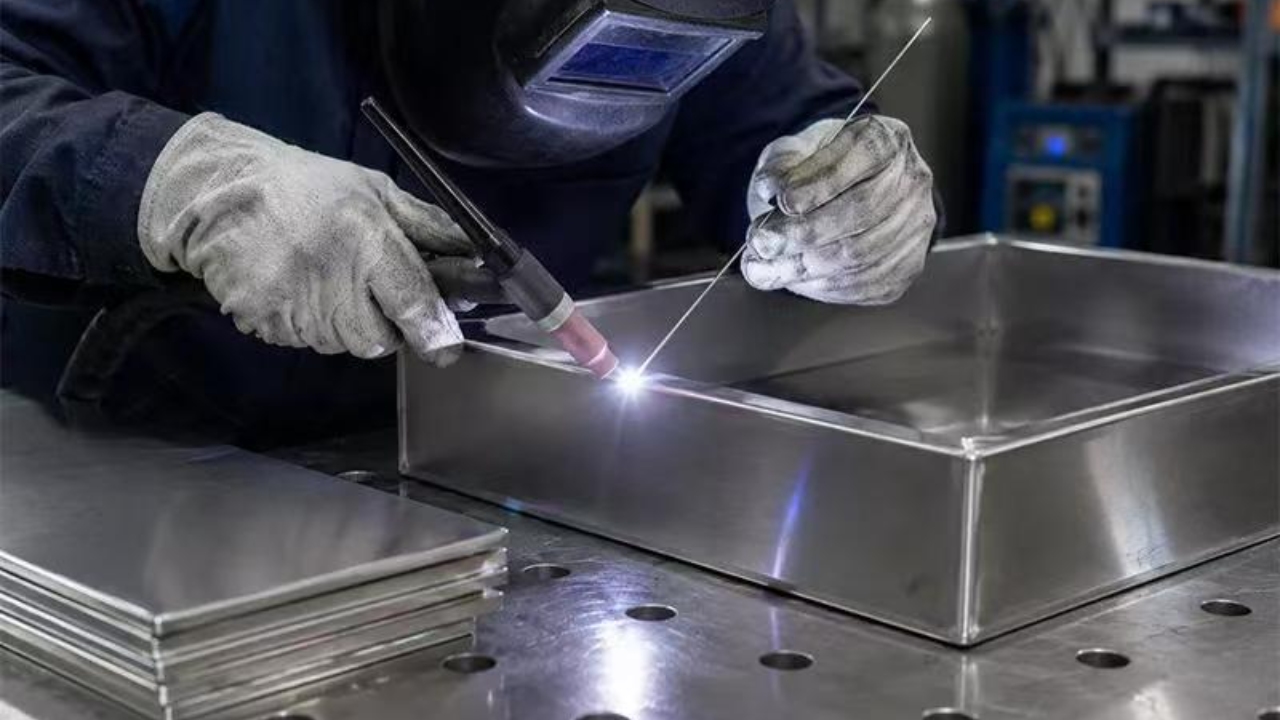
Welding is a method used to join stainless steel components. This can be done by using a combination of heat and pressure. In common fusion welding processes, the edge of the base material is melted to form a joint. This can be combined with filler material.
Welding is widely used with stainless steel sheet metal fabrication. It can be used to produce frames, tanks, cabinets, brackets and bespoke metal components.
Common Types Of Welding
MIG Welding
MIG (Metal Inert Gas) welding uses a consumable wire electrode. This is fed through the welder with shielding gas.
This type of welding can be used for manufacturing purposes, longer welds and larger stainless steel components. Due to a relatively high deposition rate, it can help improve your manufacturing efficiency.
TIG Welding
TIG (Tungsten Inert Gas) welding uses a non-consumable tungsten electrode. If needed filler material can be used separately.
TIG welding provides excellent heat control. It is often used for thin gauge stainless steel sheets, intricate components and visible welds.
Differences Between Rivets And Welding
Both methods are used to join components together, however they can have different effects.

Joining Method
Rivets use mechanical fixings to join metal sheets together. Aligned holes and the correct type of rivets will be needed.
Welding uses a welding process to join the metal components. Usually, the base material is melted at the joint. Fixings aren’t needed.
Joint Strength
Rivets will depend on the type of rivet, diameter, number of rivets, gaps between holes, thickness of metal sheets and joint design. Structural rivets can give good reliable joints if the correct type is chosen. They can be used for tensile and shear loads.
Welds can provide strong, continuous joints if the welding process and joint preparation is done correctly. They are often used for stainless steel structures.
Heat And Warping
One benefit of using rivets is they don’t require much heat to be used. This helps to prevent warping, discolouration and changing dimensions of your stainless steel sheet metal components.
Welding can cause warping due to heat being applied to the base material. This can cause shrinkage, warping and changes to the surrounding area. Thin gauge stainless steel sheets are particularly sensitive to heat. The correct welding parameters should be used.
Appearance
Riveted joints will usually leave visible heads. This may be acceptable for industrial housings, internal brackets and fixings.
Welded joints can be ground, brushed and polished to give a smooth continuous surface. This makes welding ideal for visible joints and surfaces.
Material Compatibility
Rivets can be used to join different materials together. For example stainless steel and aluminium. However, the material of the rivets and joint design should be compatible. Galvanic corrosion should be considered when joining dissimilar materials.
Joining different materials can be difficult when welding. As they are different materials they will have different melting points, thermal expansion and metallurgy. The correct welding process and filler material should be considered.
Cost And Manufacturing Efficiency
Rivets will require extra fixings. This can cause extra manufacturing time. However, rivets can be automated to improve manufacturing efficiency when producing repetitive sheet metal components.
Welding will require welding equipment, consumables and skilled workers. Extra costs may also be incurred during grinding, cleaning and finishing. However, there is no need for extra fixings, and welded joints can be continuous.
Maintenance
Riveted joints are generally seen as permanent mechanical joints. However they can be drilled or cut out. This may cause damage to surrounding components.
Welded joints are also permanently joined. They are usually harder to separate. Usually cutting or grinding will be required which could affect the original components.
When Should I Choose Riveting Or Welding?
Depending on your component design and functionality, you may wish to choose between riveting or welding. Neither method will be suitable for all applications.
When Should I Choose Riveting?

Riveting can be a great option if:
- You need to join thin stainless steel sheets with minimal heat.
- Your component contains multiple materials. The rivets should be compatible.
- The back of the joint will be hard to reach.
- Your component design will allow visible fixings.
- You need to join panels, brackets, covers or housings.
For example, stainless steel equipment cabinets can be riveted to join internal brackets and external covers. This helps make assembly easier and prevents deformation caused by heat.
When Should I Choose Welding?
Welding would generally be a better option if:
- You need permanent joints.
- Your component requires continuous joints.
- You need a smooth/continuous finish.
- Your component requires reliable transfer of forces. With joints designed correctly.
- Your component contains tanks, frames or industrial equipment.
For example, tanks and equipment frames often use welding to join sheet metal components. This forms a permanent structure.
How To Choose The Correct Method
Consider the below factors when choosing between riveting or welding.
Stainless Steel Grade
Depending on the grade of stainless steel you need, they will have different mechanical and corrosive properties. Consider if you need to use 201, 304, 316 or 316L stainless steel. The correct welding/riveting process and fixing materials should be compatible with the base material and environment.
Sheet Thickness
Thin gauge stainless steel sheets can be more sensitive to heat during welding. A riveted joint could be a good option if the joint design allows.
Structure
Consider what forces will be applied to your component. Tensile, shear, vibration and fatigue. The strength of your joint will depend on the design, material and quality of manufacturing.
Surface Finish
If you need a smooth surface without visible fixings, welding with grinding, brushing and polishing may be a better option.
Quantity And Cost
Consider what cost will be incurred during labour, equipment, consumables, fixings, finishing and inspection. Depending on how many components you need to manufacture, the most cost effective method may vary.
Maintenance
If you need to replace some components, it may be more practical to use a mechanical fixing.
FAQ
Can I use both riveting and welding on my stainless steel component?
Yes! Some components will use both methods. Welding can be used to create permanent structural joints. Rivets can be used to secure covers, brackets and removable sections. This can help give you more flexibility with your product design.
Which is stronger, riveting or welding?
Generally, welding will provide a stronger, more integrated joint compared to riveting. This makes it ideal for products which require a strong structure and long lasting. Riveting uses mechanical fixing. The strength of the joint will depend on the size of rivets, number of rivets, positioning of holes and thickness of sheet.
Why are rivets commonly used in aircraft?
Many aircraft structures are made from aluminium alloys. This can be sensitive to heat from welding. Using welding can weaken the material and cause deformation. Riveting doesn’t require a lot of heat and is easier to inspect and repair. Individual rivets can be replaced.
Are riveted joints waterproof?
Yes. However extra sealing will be required. Gaskets or sealing washers will need to be added. With welding you can have continuous welds which can form a watertight joint. This makes it more suitable for tanks, liquid containers and watertight metal housings.
What are the two common ways of riveted joints failing?
There are two common ways of riveted joints failing. Shear failure and bearing failure. This can depend on the external forces, rivet specifications and sheet thickness.
Shear Failure – This can occur when the shear force applied to the joint exceeds the load carrying capability of the rivet. The rivet can break along the shear plane. This is common in high lateral loads on riveted structures.
Bearing Failure – This can occur when the contact force between the rivet and hole exceeds the bearing strength of the sheet. The material surrounding the rivet hole can deform causing the hole to increase in size.
Final Thoughts
There are many ways of joining sheet metal components. Welding and riveting are two of the most commonly used. There are different processes, benefits and limitations. This can make it difficult to choose the correct method.
This article explains the main differences between welding and riveting. This will help you decide which method to use for your project. Verixor offers bespoke stainless steel sheet metal fabrication services including riveting, welding, laser cutting and CNC bending. Contact us today to discuss your project requirements and find the right solution.